
How to Pack Moving Boxes: Weight, Labels and Loading Checklist
Quick answer: choose strong cartons suited to their contents, divide dense items into smaller boxes, protect fragile pieces individually, close each box securely and label the destination room on more than one side. Keep first-night essentials separate and count the boxes in each room before requesting a moving quote.
Box preparation affects how items can be carried, stacked and found at delivery. A removalist team can load and protect furniture carefully, but if boxes are overfilled, unlabelled, weak or full of loose fragile items, the move becomes harder at both pickup and delivery.
Who this box-packing guide helps
Use this guide when packing your own cartons for a Melbourne home, unit or apartment move. The checks apply whether you are moving a few selected items or a full household. Confirm the complete inventory and access conditions before choosing the truck; neat packing alone does not determine whether everything will fit.
- 10 tonne truck: often suitable for many 3-4 bedroom homes, townhouses and larger apartment moves when boxes are packed clearly.
- 12 tonne truck: often better for 4-5 bedroom style homes, larger furniture loads, outdoor items, garage storage and many cartons.
- Box preparation: strong boxes, clear labels, manageable loads and separate first-night items help the crew identify and handle each group.
- Quote preparation: photos of packed boxes, large furniture, stairs and parking help JD Movers estimate truck size and timing.
Request a free moving quote Include both suburbs, box count, access notes and furniture photos.
Before you seal each moving box
| Check | What to confirm |
|---|---|
| Carton condition | No softened base, damaged corners or splitting seams; replace a weak carton rather than relying on extra tape. |
| Contents and weight | Divide dense items between smaller cartons and keep the load manageable. Ask the removalist about awkward or unusually heavy items. |
| Internal protection | Wrap fragile pieces individually and fill gaps so the contents do not move freely. |
| Closure | The base is secured and the top closes without bulging or exposed items. |
| Destination room and box number | Write on more than one side, add a short contents label and record the box in your room-by-room list. |
| Items to open first | Separate essentials you are taking with you and mark any priority cartons that will travel in the truck. |
Why box packing matters on a 10 tonne move
A 10 tonne truck can suit many 3-4 bedroom style moves, apartment relocations and townhouse moves. It can carry furniture, whitegoods, mattresses, packed boxes, small outdoor items and garage items when the load is organised.
For any household move, tell the crew about fragile cartons, unusual sizes and boxes that cannot be stacked. Group boxes by destination and keep labels visible. Do not assume that choosing a particular truck size removes the need to check carton condition, weight and the loading plan.
The aim is not to make every box perfect. The aim is to make the boxes safe to carry, easy to identify and sensible to stack inside the truck.
10 tonne vs 12 tonne: how packing changes
A 10 tonne truck is usually suitable for many 3-4 bedroom style Melbourne moves. Good packing becomes especially important because the truck space should be used carefully. Strong boxes, clear labels and predictable weights help the team build a stable load.
A 12 tonne truck is often better for a 4-5 bedroom style home with more bedrooms, more garage storage, outdoor furniture, bulky lounges and a higher number of boxes. With a larger truck, the same packing rules still apply, but there is more room to separate fragile items and larger furniture.
If you are unsure which truck size you need, send JD Movers photos of the rooms, garage, box piles and bulky furniture before booking. Compare the inventory and access checks in the Melbourne moving truck size guide.
Use the right box sizes
Putting dense items into a large carton can make the load difficult to handle. Large boxes should be used for lighter items, while smaller boxes should be used for heavy items.
- Use small boxes for books, plates, tools, pantry jars and heavy kitchen items.
- Use medium boxes for general household items and mixed room contents.
- Use large boxes for bedding, pillows, towels, soft toys and light bulky items.
- Use wardrobe boxes for hanging clothes if you want to reduce folding and creasing.
- Avoid half-collapsed or weak boxes from old deliveries.
- Do not make any box so heavy that one person cannot safely lift it.
Consistent box sizes also help the movers stack safely inside the truck.
Box weight rule for moving day
A practical rule is simple: if you struggle to lift the box, it is too heavy. Overweight boxes can split, slow the move and increase the chance of dropped items.
- Keep heavy boxes small.
- Fill empty space with paper, towels or soft items so contents do not shift.
- Do not pack books, glassware and tools together in one large box.
- Spread heavy items across multiple boxes.
- Mark heavy boxes clearly so the team can plan the loading order.
For a 10 tonne move, heavy boxes are usually loaded low and toward stable sections of the truck. Light boxes and soft items can help fill gaps later in the load.
Tape boxes properly
Good tape is cheap compared with broken belongings. Tape the bottom of every box before packing, even if it looks strong.
- Use proper packing tape, not masking tape or thin office tape.
- Tape along the centre seam and across both ends of the base.
- Use extra tape for heavy boxes.
- Close the top fully so boxes can be stacked.
- Do not leave open boxes unless they are clearly meant to stay open and travel separately.
Open-top boxes often slow loading because they cannot be stacked safely.
How to pack fragile items
Fragile boxes need more than the word “fragile” written on top. The contents must be protected inside the box.
- Wrap each glass, cup, vase or ceramic item individually.
- Place heavier fragile items at the bottom and lighter items above.
- Use packing paper, towels or bubble wrap to fill gaps.
- Pack plates vertically like records instead of flat stacks.
- Mark fragile boxes on the top and at least two sides.
- Tell the movers where fragile boxes are before loading starts.
For more detail, see our fragile items packing guide.
Label boxes by destination room
Many customers label boxes by contents only. That helps later, but it does not always help the movers place boxes correctly. The most useful label is the destination room.
- Kitchen – plates
- Master bedroom – clothes
- Bedroom 2 – books
- Study – monitor cables
- Laundry – towels
- Garage – tools
At delivery, room labels help the team place boxes where they belong. If two rooms have similar names, agree on a simple numbering system and show the crew which room is which.
Colour labels and priority boxes
If you have time, use colour labels or large marker writing. The goal is fast recognition when boxes are moving quickly.
- Use one colour for each main room.
- Write on the side of the box, not only the top.
- Mark “open first” on essential boxes.
- Mark “heavy” on boxes that need careful lifting.
- Mark “fragile” on multiple sides.
- Keep a simple box count for each room.
Good labelling reduces repeated questions during unloading and helps you unpack in the right order.
What not to pack in moving boxes
Separate personal essentials from the general load so you can reach them during the move. Items that can leak, spoil or create a hazard need their own assessment, not just a different box.
- Passports, IDs and legal documents.
- Medication and health items.
- House keys, car keys, fobs and remotes.
- Cash, jewellery and small valuables.
- Laptops, chargers and work essentials.
- Food that can leak or spoil.
- Open liquids, chemicals or cleaning products that may spill.
- Items needed for children or pets on moving day.
Keep documents, keys, valuables and daily essentials with you. Do not treat a personal essentials bag as a way to transport leaking or hazardous products. Ask the removalist what it can accept and follow the product instructions before making separate arrangements. You can also use our moving essentials checklist to prepare first-night items.
How packed boxes affect truck loading
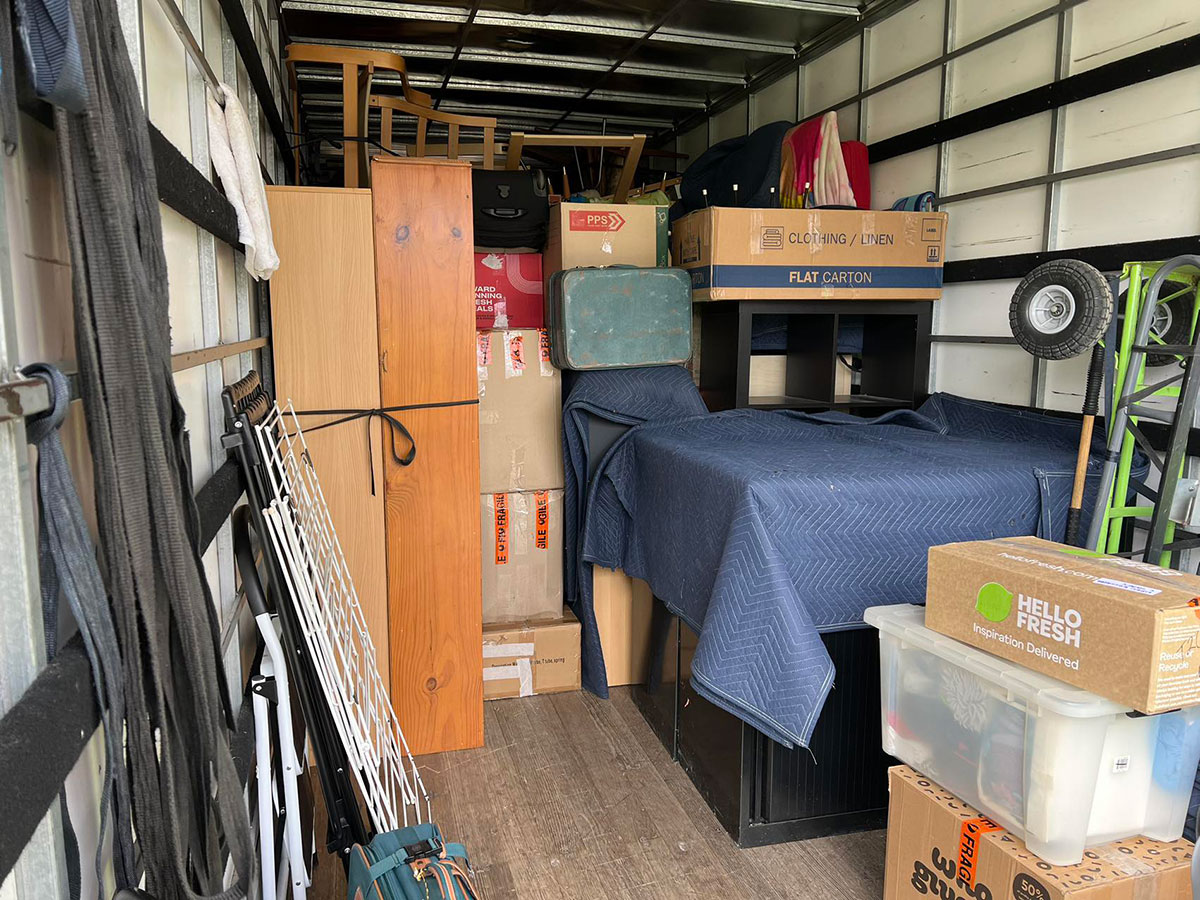
The photo shows cartons and covered furniture together inside a truck. It illustrates why the carton list needs to be considered alongside furniture, rather than treated as a separate estimate. Flag cartons that need special positioning before loading begins.
Discuss these loading priorities with the crew:
- Heavy boxes low.
- Fragile boxes separated and protected.
- Furniture wrapped before tight stacking.
- Mattresses and flat panels placed upright where safe.
- Loose small items packed into boxes before loading.
- Priority boxes placed where they can be found at delivery.
Good packing helps the removalists load more efficiently and unload with fewer delays.
Apartment and unit packing notes
For apartment or unit moves, box packing should also account for lift access, stairs and hallway carry distance.
- Do not leave loose items in hallways.
- Keep boxes closed so they can be moved quickly through lifts.
- Use smaller boxes if stairs are involved.
- Group boxes near the exit only if it does not block access.
- Tell building management if a lift booking is required.
- Keep fragile boxes away from heavy traffic areas.
Confirm the lift booking and carrying route before the crew arrives; do not stage cartons where they block shared access.
What to tell JD Movers when booking
To recommend the right truck and timing, JD Movers needs a realistic picture of the move.
- Pickup and delivery suburbs.
- Apartment, unit, townhouse or house.
- Bedroom count.
- Approximate number of boxes.
- Whether boxes are already packed.
- Stairs, lift access, loading bay or parking restrictions.
- Large or fragile items such as TVs, mirrors, glass cabinets and artwork.
- Whether you may need a 10 tonne or 12 tonne truck.
You can also check our Melbourne removalist cost guide before requesting a quote.
Trust proof from Melbourne customers
JD Movers receives strong feedback from Melbourne customers for careful handling and protected loading. One 5-star Google review said the team had items “stacked properly and safely”, and another customer mentioned large furniture and contents being protected during the move.
That matters for box packing too. The best result comes from both sides working together: customers prepare strong, labelled boxes, and the removalist team loads them carefully with protected furniture and a stable truck plan.
You can read more customer feedback on our testimonials page.
Useful JD Movers pages for planning this move
- Removal services Melbourne
- Furniture removals Melbourne
- Removal insurance information
- Blackburn removalists
- Burwood East removalists
- Request a free moving quote
5, 10 and 12 tonne truck planning
JD Movers does not choose a truck by suburb name alone. We compare the property type, bedroom count, box estimate, lift or stair access, parking distance, bulky furniture and whether the job is a full home move, apartment move, office move or selected-item move.
| Truck option | Best fit | Planning note |
|---|---|---|
| 5 tonne truck | 1-2 bedroom units or apartments, small item lists, student moves, compact access or partial furniture moves. | A 5 tonne truck is useful when the load is smaller and parking or apartment access is tighter. |
| 10 tonne truck | 3-4 bedroom apartments, units, townhouses or prepared smaller homes with boxes, beds, lounges and whitegoods. | A 10 tonne truck gives more capacity for a normal household load while still being practical for many Melbourne streets. |
| 12 tonne truck | 4-5 bedroom homes, larger family moves, garage items, outdoor furniture, heavy pieces or commercial stock. | A 12 tonne truck is better when volume, bulky furniture or loading separation matters more than compact access. |
For a more accurate quote, send the pickup and delivery suburbs, property type, bedroom count, box estimate, stairs or lift details, parking notes and photos of large or fragile items.
FAQs about packing boxes for moving house
How early should I start packing boxes?
Start non-essential items two to four weeks before moving day. Leave daily-use kitchen, bathroom and first-night items until the final stage.
How heavy should moving boxes be?
A box should be light enough for one person to lift safely. Use small boxes for books, tools and heavy kitchen items.
Should I label boxes by room or contents?
Do both if possible. The destination room helps movers unload faster, while contents help you unpack later.
Can a 10 tonne truck handle a 3-4 bedroom move?
Often yes, depending on box count, furniture volume, access and how much garage or outdoor storage is included. A 12 tonne truck is usually better for larger 4-5 bedroom style homes.
Can JD Movers help if I have fragile boxes?
Yes. Tell the team which boxes are fragile before loading starts so they can be separated, protected and placed carefully in the truck.
Ready to move your packed boxes safely?
If you are moving from Blackburn, Burwood East or another Melbourne suburb, send JD Movers your route, box count, property type, access details and photos of large furniture. We will help you choose the right truck and plan the loading order.
Get a free moving quote and include both suburbs, box count, access notes and photos of larger furniture.