
How to Pack Moving Boxes: Weight, Labels and Loading Checklist
Quick answer: choose strong cartons suited to their contents, divide dense items into smaller boxes, protect fragile pieces individually, close each box securely and label the destination room on more than one side. Keep first-night essentials separate and count the boxes in each room before requesting a moving quote.
Box preparation affects how items can be carried, stacked and found at delivery. A removalist team can load and protect furniture carefully, but if boxes are overfilled, unlabelled, weak or full of loose fragile items, the move becomes harder at both pickup and delivery.
Who this box-packing guide helps
Use this guide when packing your own cartons for a Melbourne home, unit or apartment move. The checks apply whether you are moving a few selected items or a full household. Confirm the complete inventory and access conditions before choosing the truck; neat packing alone does not determine whether everything will fit.
- Box preparation: strong boxes, clear labels, manageable loads and separate first-night items help the crew identify and handle each group.
- Quote preparation: photos of packed boxes, large furniture, stairs and parking help JD Movers estimate truck size and timing.
Request a free moving quote Include both suburbs, box count, access notes and furniture photos.
Before you seal each moving box
| Check | What to confirm |
|---|---|
| Carton condition | No softened base, damaged corners or splitting seams; replace a weak carton rather than relying on extra tape. |
| Contents and weight | Divide dense items between smaller cartons and keep the load manageable. Ask the removalist about awkward or unusually heavy items. |
| Internal protection | Wrap fragile pieces individually and fill gaps so the contents do not move freely. |
| Closure | The base is secured and the top closes without bulging or exposed items. |
| Destination room and box number | Write on more than one side, add a short contents label and record the box in your room-by-room list. |
| Items to open first | Separate essentials you are taking with you and mark any priority cartons that will travel in the truck. |
Plan cartons together with the rest of your inventory
For any household move, tell the crew about fragile cartons, unusual sizes and boxes that cannot be stacked. Group boxes by destination and keep labels visible. Do not assume that choosing a particular truck size removes the need to check carton condition, weight and the loading plan.
Include the carton estimate alongside furniture, appliances and access details. Compare the inventory checks in the Melbourne moving truck size guide; bedroom count alone does not determine the vehicle.
Use the right box sizes
Putting dense items into a large carton can make the load difficult to handle. Large boxes should be used for lighter items, while smaller boxes should be used for heavy items.
- Use small boxes for books, plates, tools, pantry jars and heavy kitchen items.
- Use medium boxes for general household items and mixed room contents.
- Use large boxes for bedding, pillows, towels, soft toys and light bulky items.
- Use wardrobe boxes for hanging clothes if you want to reduce folding and creasing.
- Avoid half-collapsed or weak boxes from old deliveries.
- Follow the carton specification and identify difficult loads before moving them; do not use a trial lift as a safety test.
Choose sizes that suit the contents and the required protection. Compare dated retail examples in our moving boxes price guide; a lower box price does not establish that it is suitable for heavy or fragile items.
Plan carton weight and handling before lifting
Do not judge a carton only by whether you can lift it once. Size, grip, balance, repeated carrying, stairs and the route also matter. WorkSafe Victoria’s manual-handling guidance explains why force, posture and movement must be considered together.
- Divide dense contents into suitable smaller cartons instead of overloading one large box.
- Record the weight if known and flag unusual or hard-to-hold loads.
- Keep access clear and discuss appropriate equipment or assistance with the moving team.
- Follow the carton rating without treating it as a personal lifting limit.
WorkSafe’s moving and lifting guidance includes reducing difficult loads and using suitable handling arrangements. Do not attempt a lift that feels unsafe just to complete packing or take a photograph.
Tape and close boxes according to their design
Follow the carton manufacturer’s assembly and closure instructions, including the tape and seams specified for that design. A self-locking carton may close differently from a standard taped box.
- Check the assembled base before adding contents.
- Use suitable packing tape where required, not thin office tape as a substitute.
- Replace a damaged carton or reduce an overloaded one; extra tape does not correct either problem.
- Close the top without bulging, forcing the flaps or exposing contents.
- Discuss unusual or unsealed containers with the mover before collection.
Keep a box accessible until you have checked its contents and label. Do not assume that a closed lid makes every carton suitable for stacking.
How to pack fragile items
Fragile boxes need more than the word “fragile” written on top. The contents must be protected inside the box.
- Wrap each glass, cup, vase or ceramic item individually.
- Keep incompatible items apart and prevent one piece from pressing on another.
- Use wrapping and cushioning suited to the surface and shape; prevent items from moving into direct contact.
- Pack plates vertically like records instead of flat stacks.
- Mark fragile boxes on the top and at least two sides.
- Tell the movers where fragile boxes are before loading starts.
For more detail, see our fragile items packing guide, the glassware packing steps and the separate artwork preparation guide. Delicate originals, damaged pieces and unusual items may need specialist assessment rather than ordinary carton packing.
Label boxes by destination room
Many customers label boxes by contents only. That helps later, but it does not always help the movers place boxes correctly. The most useful label is the destination room.
- Kitchen – plates
- Master bedroom – clothes
- Bedroom 2 – books
- Study – monitor cables
- Laundry – towels
- Garage – tools
At delivery, room labels help the team place boxes where they belong. If two rooms have similar names, agree on a simple numbering system and show the crew which room is which.
Colour labels and priority boxes
If you have time, use colour labels or large marker writing. The goal is fast recognition when boxes are moving quickly.
- Use one colour for each main room if helpful, and also write the room name.
- Write on the side of the box, not only the top.
- Mark “open first” on essential boxes.
- Mark “heavy” on boxes that need careful lifting.
- Mark “fragile” on multiple sides.
- Keep a simple box count for each room.
Good labelling reduces repeated questions during unloading and helps you unpack in the right order.
What not to pack in moving boxes
Separate personal essentials from the general load so you can reach them during the move. Items that can leak, spoil or create a hazard need their own assessment, not just a different box.
- Passports, IDs and legal documents.
- Medication and health items.
- House keys, car keys, fobs and remotes.
- Cash, jewellery and small valuables.
- Laptops, chargers and work essentials.
- Food that can leak or spoil.
- Open liquids, chemicals or cleaning products that may spill.
- Items needed for children or pets on moving day.
Keep documents, keys, valuables and daily essentials with you. Do not treat a personal essentials bag as a way to transport leaking or hazardous products. Ask the removalist what it can accept and follow the product instructions before making separate arrangements. You can also use our moving essentials checklist to prepare first-night items.
Give the crew a usable carton inventory
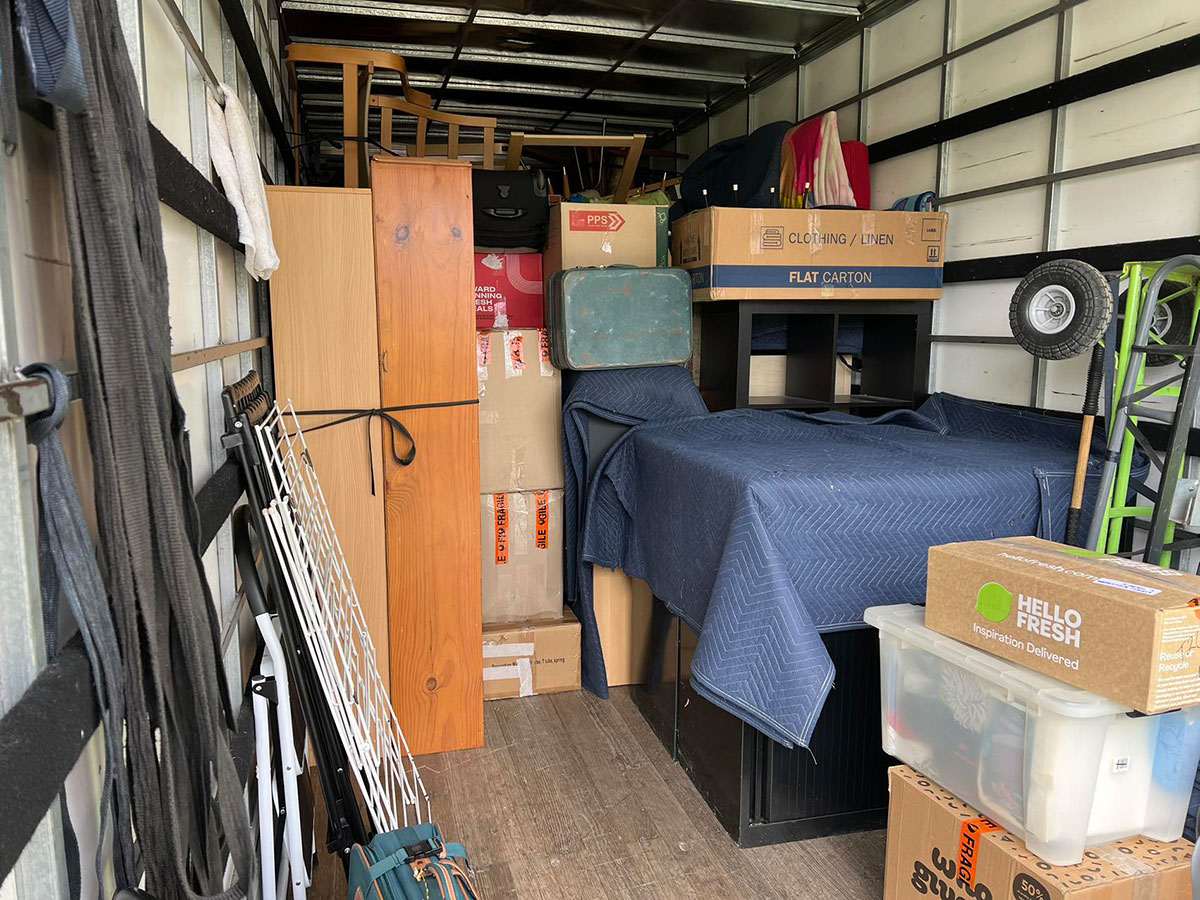
The photo shows cartons and covered furniture together inside a truck. It illustrates why the carton list needs to be considered alongside furniture, rather than treated as a separate estimate. Flag cartons that need special positioning before loading begins.
Share a room-by-room count and identify fragile, priority and non-stackable packages. Keep labels visible and tell the crew if the actual count differs from your quote estimate. The loading position should follow the complete load plan, not a rule that every heavy carton or fragile box goes in the same place.
Apartment and unit packing notes
For apartment or unit moves, box packing should also account for lift access, stairs and hallway carry distance.
- Do not leave loose items in hallways.
- Keep boxes closed so they can be moved quickly through lifts.
- Describe stairs and carrying distances before agreeing on carton handling; smaller boxes alone do not remove access risks.
- Group boxes near the exit only if it does not block access.
- Confirm any required lift booking with building management.
- Keep fragile boxes away from heavy traffic areas.
Confirm the lift booking and carrying route before the crew arrives; do not stage cartons where they block shared access.
What to tell JD Movers when booking
To recommend the right truck and timing, JD Movers needs a realistic picture of the move.
- Pickup and delivery suburbs.
- Apartment, unit, townhouse or house.
- Bedroom count.
- Approximate number of boxes.
- Whether boxes are already packed.
- Stairs, lift access, loading bay or parking restrictions.
- Large or fragile items such as TVs, mirrors, glass cabinets and artwork.
- Any unusually heavy, awkward or non-stackable cartons and handling instructions.
You can also check our Melbourne removalist cost guide before requesting a quote.
You can read customer feedback on our testimonials page.
Useful JD Movers pages for planning this move
- Removal services Melbourne
- Furniture removals Melbourne
- Removal insurance information
- Blackburn removalists
- Burwood East removalists
- Request a free moving quote
FAQs about packing boxes for moving house
How early should I start packing boxes?
Start with non-essential items once your move is planned. Allow time to sort, obtain suitable materials and revise the box count. Keep daily-use and first-night items accessible until the final stage.
How heavy should moving boxes be?
Follow the carton specification and consider the contents, size, grip and carrying route. Do not treat the ability to lift it once as a safety test. Split difficult loads and ask the team about unusual items.
Should I label boxes by room or contents?
Do both if possible. The destination room helps movers place the box, while a short contents description and box number help you find items later.
Can I reuse delivery boxes?
Only if they are clean, dry, undamaged and suitable for the contents. Replace cartons with softened bases, crushed corners or splitting seams, and remove misleading old labels.
Does extra tape make an overloaded box acceptable?
No. Reduce the contents or choose a suitable carton. Tape should secure the correct closure, not compensate for excess weight or damaged cardboard.
Should all boxes be packed before the moving team arrives?
Confirm the agreed preparation and any packing help before booking. If the plan assumes ready-to-move cartons, finish and label them before collection, and tell the team promptly if that changes.
Ready to move your packed boxes safely?
If you are moving from Blackburn, Burwood East or another Melbourne suburb, send JD Movers your route, box count, property type, access details and photos of large furniture. We will help you choose the right truck and plan the loading order.
Get a free moving quote and include both suburbs, box count, access notes and photos of larger furniture.